
It’s Advent time again, so here’s another round of Art Advent, during which I post inspiring, cheerful or consoling artworks I’ve seen over the past year. With 2024 being particularly rough with the world going mad on so many fronts, I continue to believe in the power of art and putting beauty, fragility and love first – in anticipation of the new year to come. I hope you’ll join me on this Art Advent once again!
The Art Advent gets daily updates on my social media and within the blog posts on this site. This is Week 3.
ART ADVENT #15 || Dec 15.
This beautiful wall can currently be admired at Stedelijk Museum Schiedam. It shows eight screen prints made by a Dutch collective that called itself “Women Constructivists “. They published a binder titled “Rechttoe-Rechtaan”, with these fabulous abstract works (plus one more that’s not on this wall). It was intended as a statement, to draw more attention to women abstract artists, who had been largely neglected in an art scene in which abstraction and masculinity were often equated. These awesome prints reinforce once more how undeserved that was.

Women Constructivists, Rechttoe-Rechtaan, 1975.
Collection of, seen at Stedelijk Museum Schiedam.
ART ADVENT #16 || Dec 16.
Everyone can be in need of sanctuary, in the most unexpected or unwanted of moments. I saw this beautiful chapel outside the DIMU in Freising. It’s titled The Chapel of Mary’s Mantle, offering an architectural cloak that welcomes you in a warm embrace, with a candle burning inside. It protects you from evil, shelters you from harm. I especially like the exterior, it’s so well-balanced and pretty with these exquisitely bricked thin tiles. While I mostly know artist Kiki Smith from her bronze sculptures (Lilith! Mary Magdalene!), it was a pleasant surprise to discover this chapel by her hand.

Kiki Smith and Brückner&Brückner Architects, The Chapel of Mary’s Mantle, 2023.
Seen at DIMU, Freising.
ART ADVENT #17 || Dec 17.
Otto van Rees painted his wife Adya in bed, while she’s working on a textile art piece. Adya realized this commissioned textile work not too long after having birthed their second daughter. As much of the care for the children rested on Adya’s shoulders, she picked up techniques like embroidery and drawing after they were born. While before becoming a mother, Adya had painted -just like Otto-, afterwards she took up techniques that were more easily interrupted and put aside for a while. That better accommodated family life. Adya’s textiles were well received by critics, commended for their warm coloring, and were exhibited almost immediately in Europe and the US. Unfortunately many of them were lost throughout the years, as textiles are fragile and were long not appreciated as highly as painting or sculpture, consequently not always treated as carefully as required. Those that remain are not often displayed because of their fragility, yet have gained critical and art historical attention again – deservedly so.
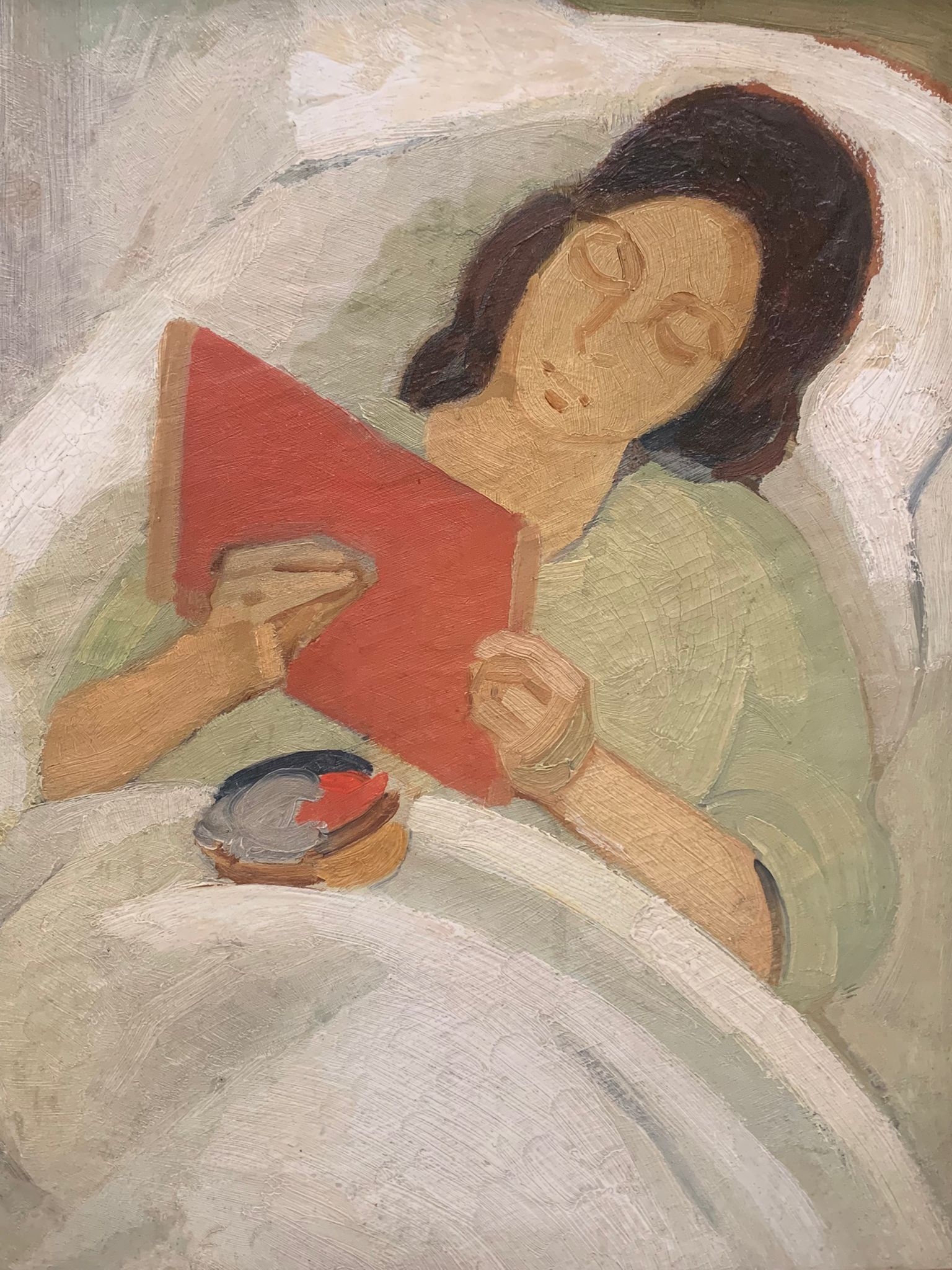
Otto van Rees, Adya embroidering in bed, 1910.
Collection CFVV, Domburg. Seen at Stedelijk Museum Schiedam
ART ADVENT #18 || Dec 18.
This spectacular field of lights offered an experience to remember. This installation was fully responsive to human presence. Walking in an entirely dark room, light beams followed your every step, but also projected your next step. This resulted in an experience that was inescapable, the light beams were inescapable. The impeccably beautiful bright lights started to feel as jail bars, keeping you trapped. Even though you could move your hands through the lights and register they are indeed a virtual experience, their constellation felt manifestly present. It was a surreal experience.
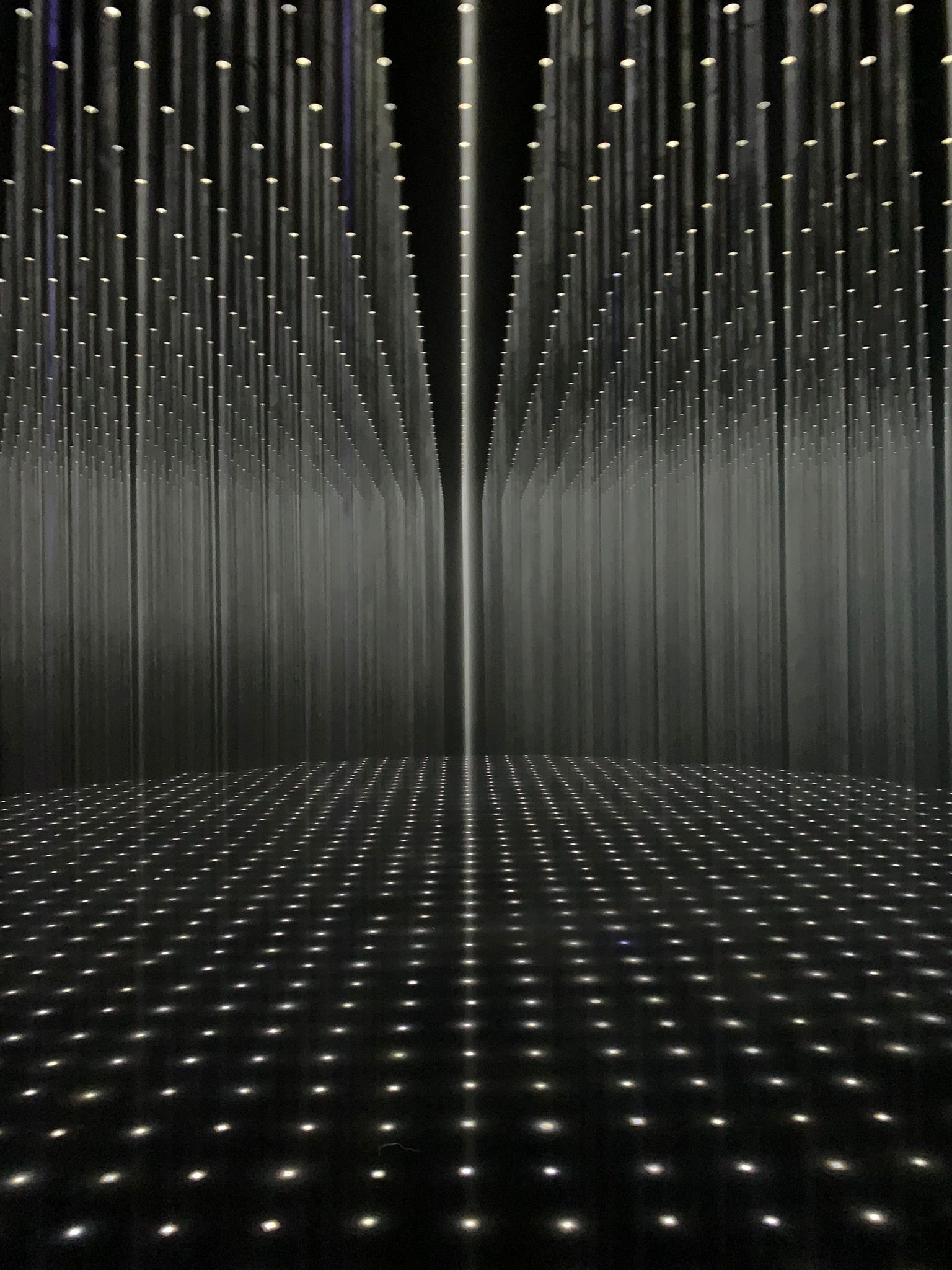
Random International, Living Room Variation II, 2023.
Seen at Museum Next, Amsterdam.
ART ADVENT #19 || Dec 19.
Today I saw this Magdalene that I had not seen before. I didn’t even know it existed. Due to a delayed meeting, I had some spare time and walked on my own on the top floor of the KMSKA in Antwerp. I have been there several times, but this was the first time this Magdalene was on display. Painted by Marlene Dumas, part of her amazing Magdalene series. The colors are beautiful but disturbing. The complex look on the woman’s face made quite an impression of me and I couldn’t let go of easily. It’s a mixture of shyness and fear. This is reinforced by her hand gestures. Painted much less intricately than the face, the hands partly cover her private parts. Her vulva is also covered by her long hair, the only traditional allusion to the art historical iconography of Mary Magdalene. In fact, the title reveals these gestures are drawn from Sandro Botticelli’s famous “Birth of Venus” painting. Other than that, Dumas’ Magdalene is a very contemporary woman, emphasizing the endurance of stereotypes women and their bodies are still subjected to today.
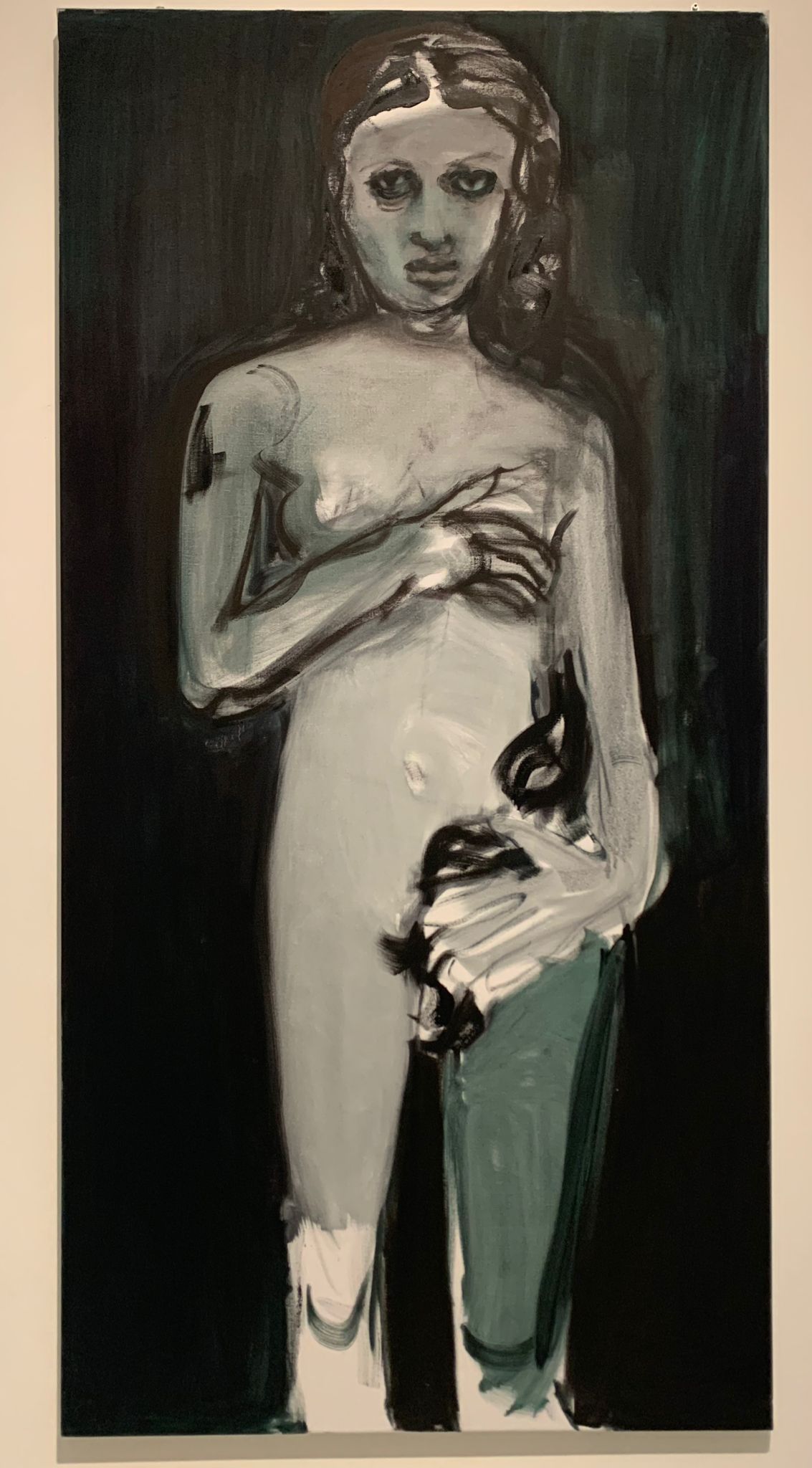
Marlene Dumas, Mary Magdalene (Venus), 1995.
Private collection. Seen KMSKA, Antwerp.
ART ADVENT #20 || Dec 20.
Sometimes you feel like a queen, just because things go well. Today was one of those days. So, here’s a special queen portrait for the advent. Elizabeth I, who was the second queen regnant of England. She was 25(!) years old when she was crowned in 1559. She was England’s second queen regnant and during the coronation she wore the robes made for her half-sister Mary five years earlier. I am not sure what impresses me more: the impeccably painted portrait or the frame that houses it.
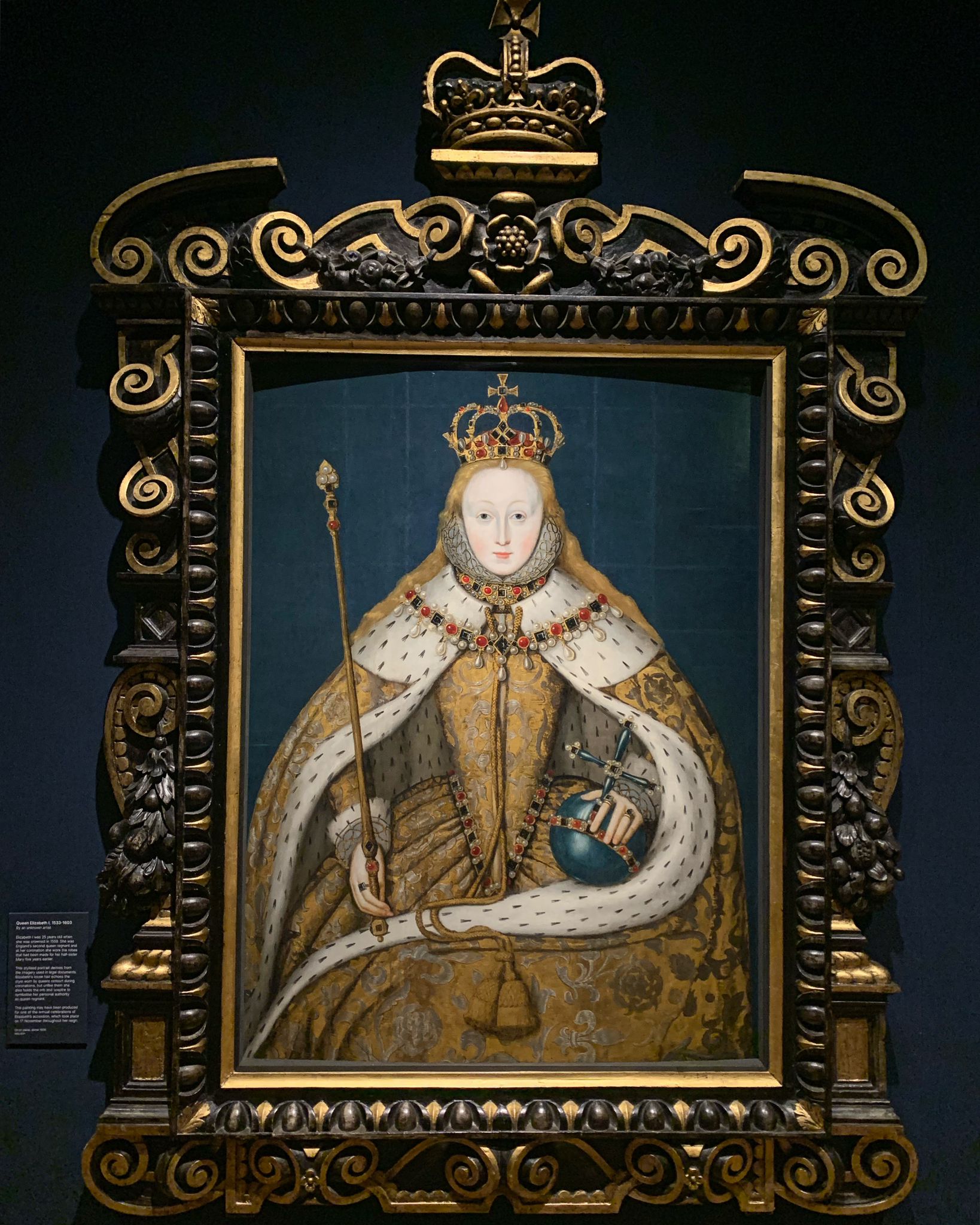
Unknown artist, Elizabeth I, ca.1600.
Collection of, seen at National Portrait Gallery, London.
ART ADVENT #21 || Dec. 21
One of my absolute favorites I saw this year, was a video from which this is a still. Belgian performer and film maker Ariane Loze made this video titled “Our Cold Loves”. Ik the video she brilliantly enacts 22 types of lovers who search for love in the digital world. The insecure honest type, who wants to come across as sharp and witty, but ends up sending generic messages about the weather (pictured in the photo). The confident, hurt before type who knows exactly what she wants and is not afraid to say it, but doesn’t really give anyone a chance. The creepy fetish type who too quickly extends an invitation to his home and feels abandoned after no longer receiving replies. All her types are spot on and she plays them marvellously. Funny, painful, embarrassing, yet all truthful.

Ariane Loze, Our Cold Loves, 2022.
Courtesy of the artist and Gallery Michel Rein, Paris/ Brussels.
Seen at Bozar, Brussels.
ART ADVENT #22 || Dec. 22
During my studies, Edouard Manet’s Olympia was a returning feature. I’ve become intrigued with the many modern and contemporary takes on the reclining female nude, with animal(s) at her feet, and with or without attendant by her side. The male gaze (how nude women have been so long throughout art history imagined, interpreted and visualized by men) was an accompanying constant feature. That is why depictions of the reclining female nude by women often have something provoking to them. Their depictions challenge and tend to alter the (visual and interpretative) narrative. I love this painting by Helen Verhoeven. And, not only because of the reinterpretation of the reclining female nude, but also because of the feline presence in this depiction. Just check out these fantastically marvellous cats.

Helen Verhoeven, Cosmic Nude #3, 2017.
Collection of, Seen at Centraal Museum, Utrecht
ART ADVENT #23 || Dec. 23
Advent is a time of anticipation for the birth of Christ. Today an artwork to put that in some perspective. The work by Lily van der Stokker is witty, sharp, and endearing, all at the same time. She has a keen eye for topics that matter in women’s lived experiences, but which are not always explicitly addressed. This small drawing makes me feel seen. I am always the no-baby friend, by choice. The choice of deliberately not having kids is still often frowned upon or misunderstood, although it has become somewhat more of a topic in public conversations this past year. Let’s keep that going, and maybe a visit to New York for 2025 in the meantime?
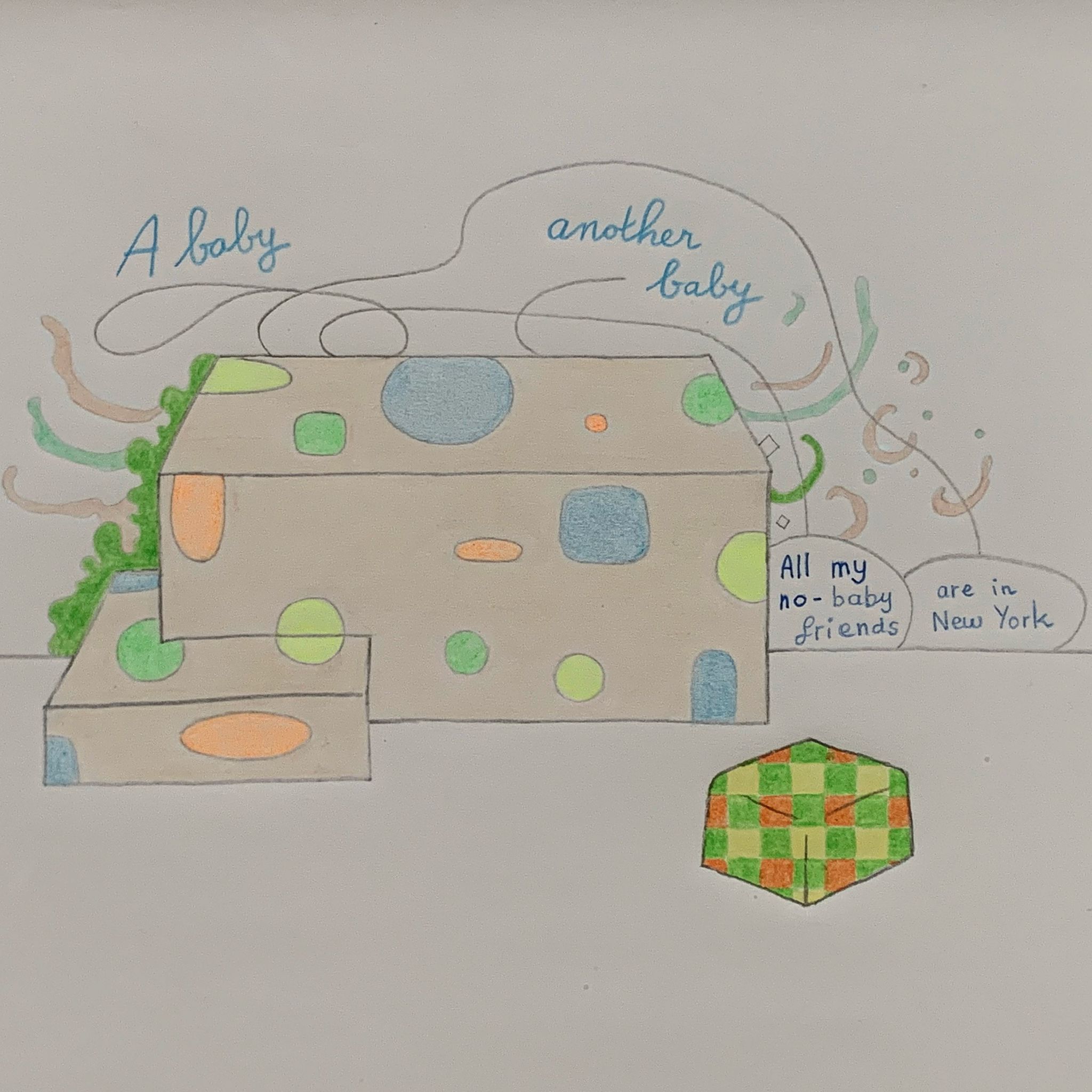
Lily van der Stokker, Baby, another baby, 2003.
Seen at Stedelijk Museum Schiedam.
ART ADVENT #24 || Dec. 24
For the final Advent post of this year, I felt this artwork an appropriate conclusion, for a period in which anticipation of a birth, in which a woman’s body has such a central role. Growing up in the nineties, with all its associated (and unrealistic) beauty standards, for me the belly was -and still is- a zone of unease. A zone of uncertainty, of normativity, of expectations. And somehow it never lives up to all that is projected on it. This year something changed though. A refusal has entered my life, to let my sense of self worth be impacted any longer by what others might think of the way I look. I feel this work by Kinke Kooi radiates such refusal. It invites a rejection of unrealistic, ridiculous, constructed standards and to embrace reality. The truth, the beauty, the strength of reality. With anticipation I look to the new year, in which I wish you much beauty, strength and truth – it feels like it is now needed more than ever. There is always art that surprises, makes you wonder, or throws you of your feet. I wish you lots of this for the year to come. And for now, a merry Christmas ❤🎄

Kinke Kooi, Sunny Day Happy Moment, 1996.
Seen at Stedelijk Museum Schiedam.

 dr. Lieke Wijnia