
It’s first Advent Sunday today, so let’s get ready for another edition of Art Advent. Until December 24, I’ll post inspiring, cheerful, thought provoking or consoling art works I’ve seen over the past year. 2025 was a bumpy ride, but I’ve learned to enjoy and appreciate the detours and unexpected turns life gives you. They bring you better places than you ever could’ve imagined. And so can art. Once again, I hope you’ll join me on this Art Advent!
ART ADVENT #1 / Nov. 30
Just last week I saw this neon sign in Boston. It hangs at the Schools & Groups entrance of the Museum of Fine Arts. I love how it playfully tells those entering the museum what they can and cannot do inside of the walls of the museum. At the same time, it also points at what to appreciate in life more generally, but what might be often forgotten in the fast-paced and overloaded lives we live: to wonder, flirt, dance, relax, touch (each other), muse. Looking at this work put a big smile on my face and made me want to do each and every one of these things – in the museum, and outside.

Jeppe Hein, Please… (2008)
In collection of, seen at MFA, Boston
ART ADVENT #2 / Dec.1
Some artworks are subject to so much reproduction, that you tend to forget about the real object behind the image. Grant Wood’s American Gothic is an image like that to me. Seeing images of it everywhere, I never really understood the work’s popularity. But then earlier this year I saw the painting (the real object!) in the Art Institute of Chicago. What a pleasure it was! Knowing it only from reproductions, seeing the painting felt like meeting the real people. Experiencing the object’s materiality made the depicted people come alive. And it made me understand their appeal. They charmed me, this father and daughter with their awkward and stiff seriousness – I found this ultimate American icon adorable.
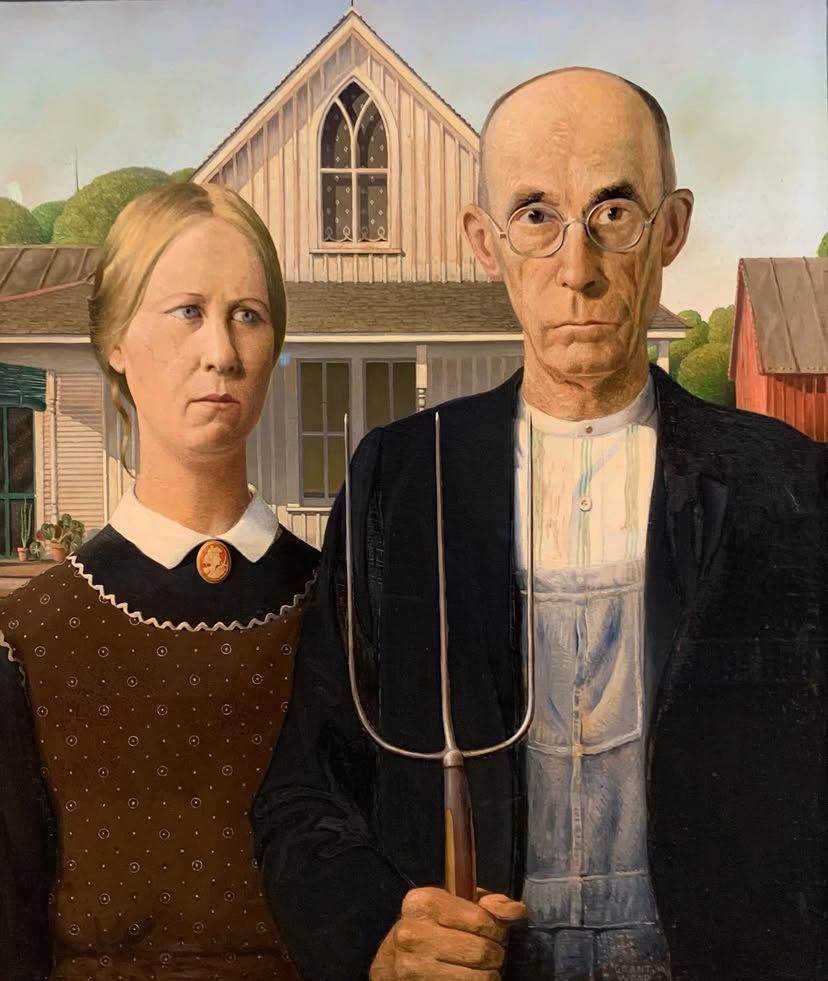
Grant Wood, American Gothic, 1930.
The Art Institute of Chicago.
ART ADVENT #3 / Dec. 2
Advent is a period of anticipation, of expectation, of hope, and of the dawn of eternal light. I feel the temple “Lumina” by Isa van Lier is an embodiment of this spirit: it delivers light at the end of a dark tunnel. Walking through it is quite a special experience, followed by stepping into a bright oval chamber inhabited by hundreds of ceramic beings. With the friendliest of faces, each unique, they invite you to reach within yourself. To literally step away from the world outside and get back in touch with the world inside yourself. With the light you carry inside, and through that the light of others. Admittedly, I adore it. If this can be my temple, then sign me up for its religion.


Isa van Lier, Lumina, 2025
Collection of the artist, now on view at Stedelijk Museum Schiedam.
ART ADVENT #4 / Dec.3
In their paintings, Impressionist artists tried to capture spontaneous, fleeting moments. As such they wanted to convey something about the permanent state of flux of human experience, of time passing by, and of the monumentality of everyday life. American painter Mary Cassatt painted two young ladies in a Parisian apartment, the one entertaining the other. She chose a somewhat cropped composition, which feels like we as viewer get a snapshot into this intimate, personal setting. A sense of spontaneity is conveyed through the sip the girl on the right is taking, right in the moment Cassatt has captured. The tea cup covering most of her face goes against most traditional conventions of posing for a painting. I love it.
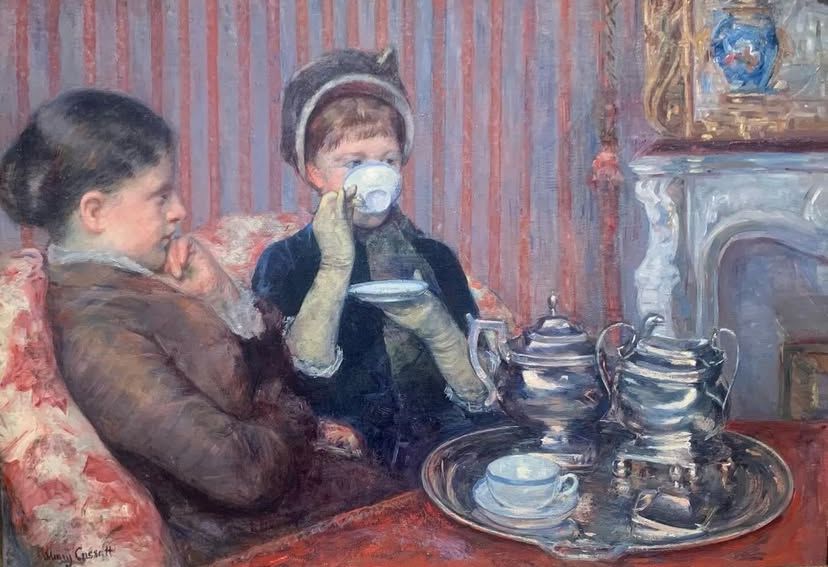
Mary Stevenson Cassatt, Le Thé, ca. 1880.
Collection of, seen at MFA, Boston.
ART ADVENT #5 / Dec. 4
Judith Leyster was the first woman to join a Dutch painters’ guild, in 1633. This was unprecedented in a world dominated and ruled by men. This fabulous portrait of an unknown woman was long thought to have been painted by the Dutch master painter Frans Hals. The brushstrokes are reminiscent of his vivid way of painting. However, as so often the case in art history, it now seems this was a case of mistaken identity. Judith Leyster’s signature was recovered in the bottom right corner of the painting and the work has subsequently been attributed to her. The likeness to Hals’ painting style is not far off – possibly she was employed by Hals as an assistant for a while. I just really love the light smile and supreme glance the portrayed woman casts over us.
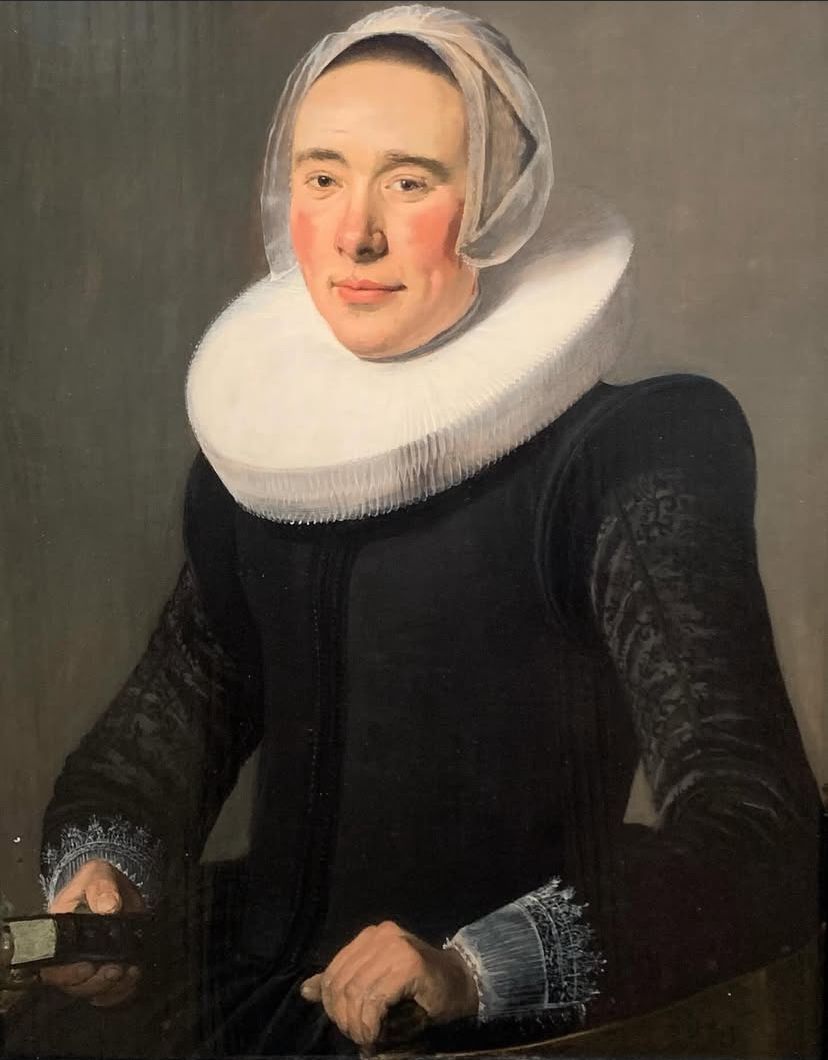
Judith Leyster, portrait of an unknown woman, 1635.
Collection of, seen at Frans Hals Museum, Haarlem.
ART ADVENT #6 / Dec.5
When Wilgefortis, a King’s daughter, refused to marry, she prayed that no man would notice her. Her wish granted by God, she started to grow a beard. This act, however, was interpreted as witchcraft and Wilgefortis was sentenced to die on the cross. Ever since she is invoked to save marital disagreements, but just as much she resonates as patron saint of wilful and independent women. This sculpture is a highlight of Catalan Baroque sculpture, it’s so beautifully crafted and detailled. The label in the museum listed her in English as Saint Wilgefortis, in Spanish as Santa Liberada. I like that latter description a lot.

Andreu Sala, Saint Wilfefortis / Santa Liberada, ca. 1689.
Collection of, seen at The National Art Museum of Catalunya, Barcelona.
ART ADVENT #7 / Dec. 6
One artwork made me cry this year. Made me shed a tear. Well, more than one, actually. It was this Edward Hopper painting I saw in the Whitney Museum in New York. One of the most white cube museums I know, where I felt utterly out of place with tears running from my eyes. But it happened nevertheless. Hopper is known for his solemn, somewhat mysterious urban scenes or landscapes, either deserted or inhabited by seemingly isolated people. Here, he painted a woman, nude in her room. It is unclear whether it is the first or last light of the day that falls upon her. But there is an utter melancholy, a profound loneliness to the painting. However, what touched me deeply was how the label described that Hopper had used his wife as model for this painting. Only, at the time of painting, his wife was 78 years old. Rather than painting from life, he had modelled her after his own memory and feelings of her. To me, this was something so intensely beautiful, I teared up.
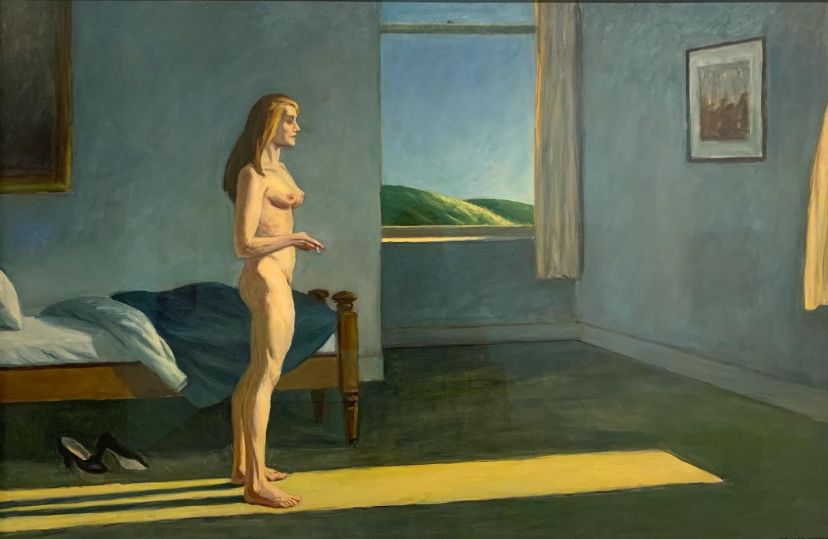
Edward Hopper, A Woman in the Sun, 1961.
Collection of, seen at The Whitney Museum, New York.

 dr. Lieke Wijnia