
It’s first Advent Sunday today, so let’s get ready for another edition of Art Advent. Until December 24, I’ll post inspiring, cheerful, thought provoking or consoling art works I’ve seen over the past year. 2025 was a bumpy ride, but I’ve learned to enjoy and appreciate the detours and unexpected turns life gives you. They bring you better places than you ever could’ve imagined. And so can art. Once again, I hope you’ll join me on this Art Advent!
Art Advent gets daily updates on my social media (Instagram and Bluesky). Here you’ll find the weekly roundups. This was week 2.
ART ADVENT #8 / Dec. 7
Today is second Advent Sunday. In one of the side chapels in the majestic St. John the Divine Cathedral in New York, stands this intriguing triptych: depicting The Life of Christ by Keith Haring. With side panels depicting angels flying or falling from the sky, the heart of the triptych focuses on Christ being held by Mary and the mourning of his death. Haring made this sculptural work in 1990, the last one before he passed away. I love the simplicity of the visual language, so distinctly and singularly Haring, which at the same time depicts the universal subject matter of eternal love and loss.
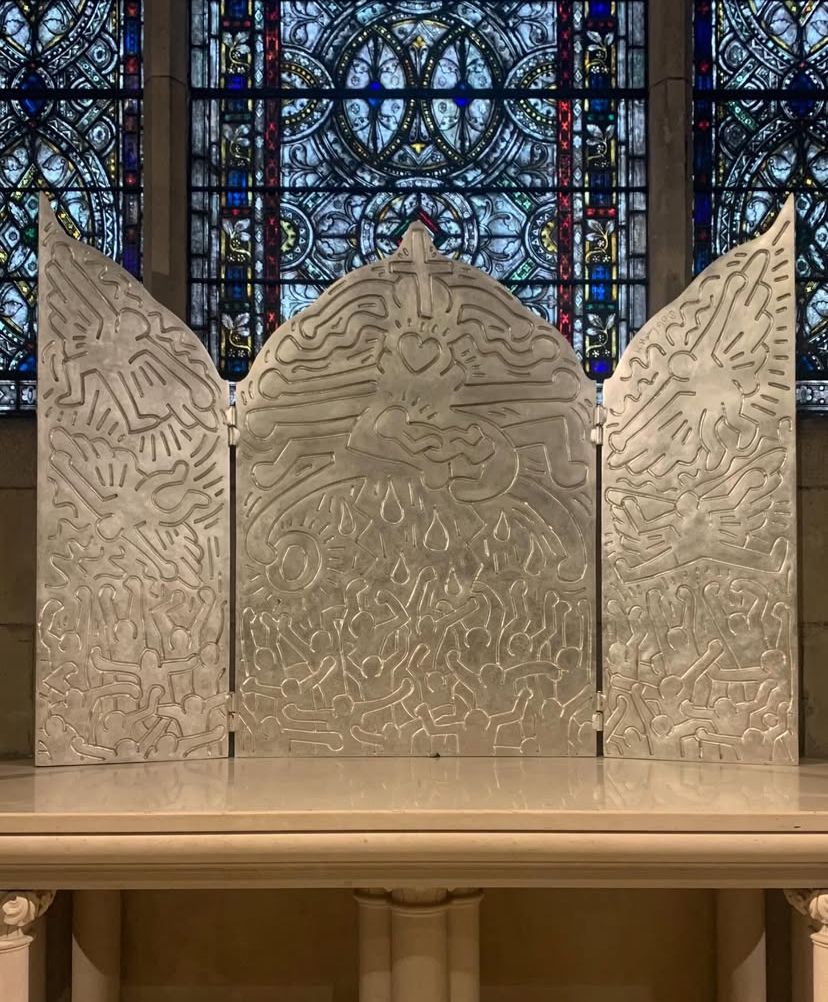
Keith Haring, The Life of Christ, 1990.
Seen at St. John the Divine, New York
ART ADVENT #9 / Dec. 8
Louise Nevelson called this wall-covering assemblage of boxes filled with objects her “Sky Cathedral.” It’s a tribute to scraps and parts she found in her neighborhood in Manhattan, which she elevated to a higher sphere. She painted the installation, and each and every object in it, black, because for her this was the ultimate color. The all-encompassing, total color: it unifies everything and nothing. For Nevelson black does not negate color, but it accepts, encompasses all colors. By painting all the objects (like spindles, dowels and architectural elements) black, she sanctifies them but also obscures their original identities. The Sky Cathedral becomes a shrine for the everyday, the discarded, the overlooked. It is an invitation to sit in front of it and ponder it all – and after leaving the museum, to look at your own surroundings with new eyes, eyes of wonder.

Louise Nevelson, Sky Cathedral, 1958.
Collection of, seen at the Museum of Modern Art, New York.
ART ADVENT #10 / Dec. 9
Edouard Manet is one of my all time favorite painters. He only painted a handful of religious scenes, and I had only ever seen one in the flesh. Until I unexpectedly, so without preparation, visited the Art Institute of Chicago (what an amazing museum!), walked into one of the 19th c. rooms and there was the counterpart of the painting I knew! Such a beautiful surprise. In Chicago they have Christ being mocked by Soldiers, depicting Christ before the crucifixion. Being mocked by soldiers, tortured, made fun of. Manet painted this in such harsh realism, a harshness suiting the story, that the painting’s first display resulted in a public outcry – the painting communicates a palpably ambiguity between Christ’s divine sanctity and Manet painting him like a real man in a studio posing as someone who suffered pain and hardship. I found it a truly remarkable experience seeing this painting for real, the texture and materiality of the work are unearthly and at the same time so Manet to me.

Edouard Manet, Christ being mocked by Soldiers, 1865.
Collection of, seen at the Art Institute, Chicago.
ART ADVENT #11 / Dec. 10
This video work is one of the opening works in the new museum on migration, Fenix in Rotterdam. Bill Viola’s Ancestors, a mother and son walking through a sand storm, over the stretch of about 20 minutes, towards as viewers. It functions as a reminder of how all human beings descend from the very first peoples who migrated from the African continent tens of thousands of years ago, moving and settling across the world. Humans are always on the move, short or long distances, forced or voluntary, longing for the place they departed from, anticipating the place they’re going.


Bill Viola, Ancestors, 2012.
Collection of, seen at Fenix, Rotterdam.
ART ADVENT 12/ Dec. 11
If you visit the Stedelijk Museum in Amsterdam, do pop into the collection presentation. One of my favorite works here is this tv screen showing Martha Rosler’s Semiotics of the Kitchen. She performs an ABC of kitchen appliances and gestures, it’s a fantastic critical performance of the stereotypical role of the women in the household. Her gestures are anything but complacent to this stereotype, yet she remains behind the kitchen counter. It’s a great second feminist wave counterweight to today’s online tradwife culture.
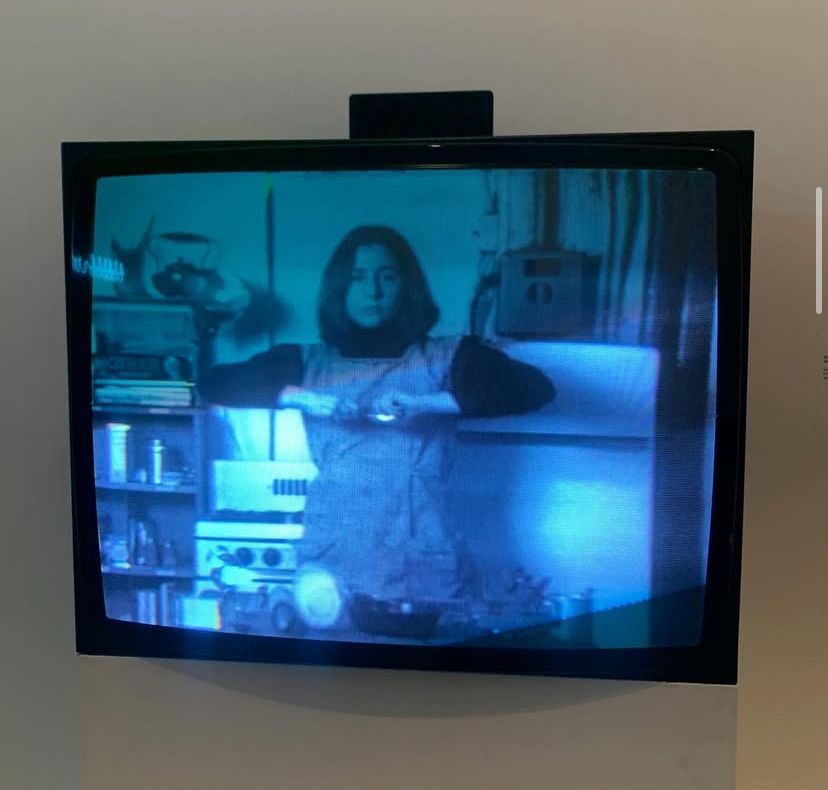
Martha Rosler, Semiotics of the Kitchen, 1975.
Seen at, collection of Stedelijk Museum, Amsterdam
ART ADVENT #13 / Dec. 12
While the Michelangelo exhibition at Teyler’s mostly focused on his drawings and sketches, this small sculpture attributed to the master caught my eye. The missing arms of the body are mirrored in the missing arms of the cross – this sculpture undeniably represents a crucified Christ. Just like the sketches in relation to his paintings, this small object is a study for a larger sculptural project. But somehow, this small jewel of an object is perfect in and of itself.
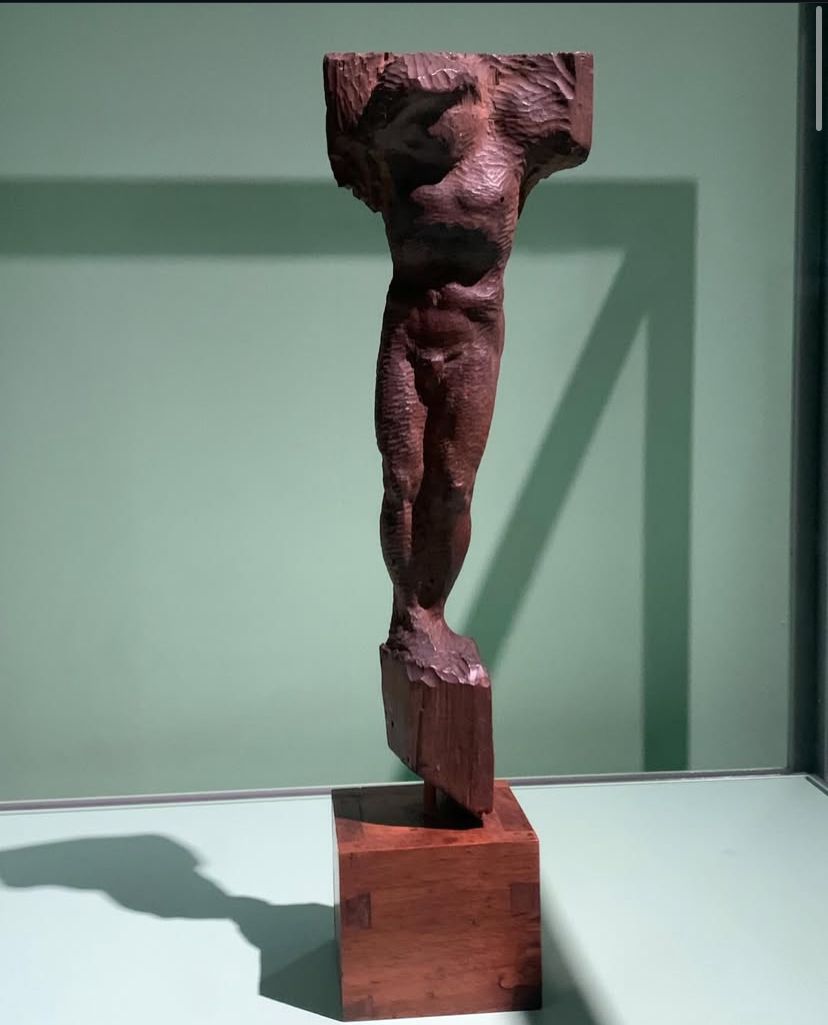
Michelangelo Buonarroti (attributed to), Study for a crucifixion, ca. 1652-53.
Collection of Casa Buonarroti, Florence.
Seen at Teyler’s Museum, Haarlem.
ART ADVENT #14 / Dec. 13
One thing I like about art is that I learn so many new things from it. This tapestry for instance, taught me about a very particular tomato – and how its existence, like so many foods and peoples, is currently under threat. Here you see the Ramisi tomato, which only grows in Qatif, the Saoudi city where artist Sara Abu Abdallah grew up. It only grows there due to the unique combination of elements in the soil. However, this produce is threathened, because of climate change, oil drillings, and urbanization. As a consequence many farms disappear from the area, profoundly impacting the tomato production. In dozens of tapestry works, Abu Abdallah has monumentalized the Ramisi tomato. They form a memory of a home that is rapidly and irreparably changing.
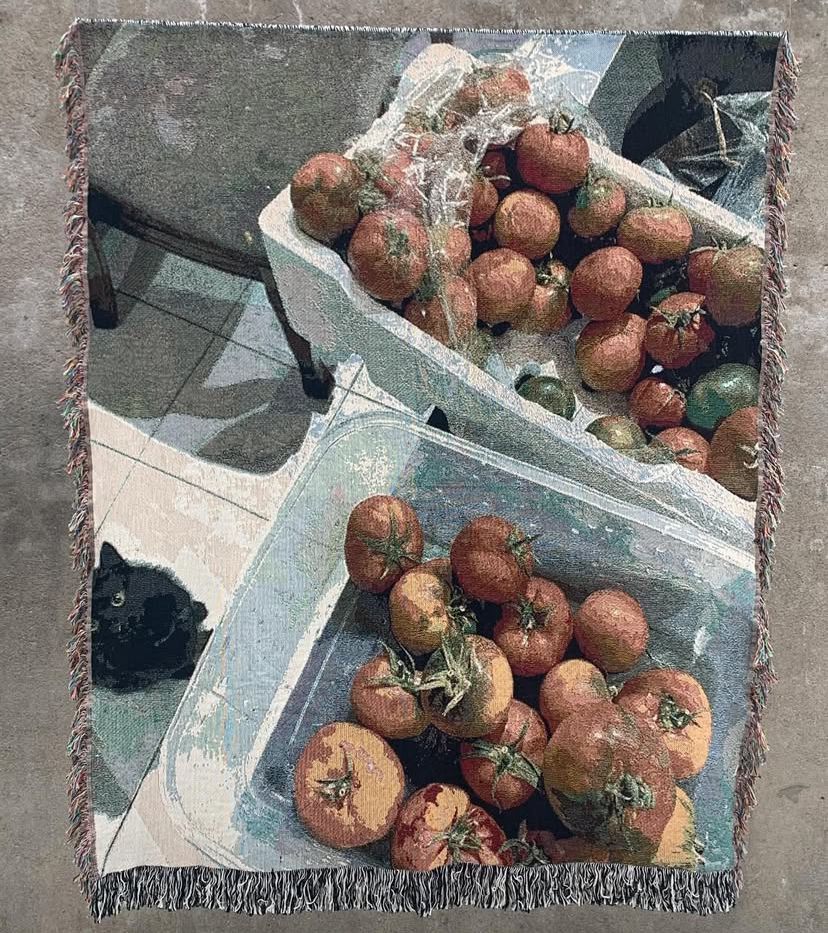
Sarah Abu Abdallah, Blanket No. 36, 2023.
Collection of, seen at Fenix, Rotterdam.

 dr. Lieke Wijnia