It’s Advent time again, so here’s another edition of Art Advent. Until December 24, I’ll post inspiring, cheerful, thought provoking or consoling art works I’ve seen over the past year. 2025 was a bumpy ride, but I’ve learned to enjoy and appreciate the detours and unexpected turns life gives you. They bring you better places than you ever could’ve imagined. And so can art. Once again, I hope you’ll join me on this Art Advent!
Art Advent gets daily updates on my social media (Instagram and Bluesky). Here you’ll find the weekly roundups. This was the last week + a bit: the finale.
ART ADVENT #15 / Dec. 14
For third Advent Sunday I picked a remarkable work by a trailblazing artist, who was instrumental for the wider acceptance of women artists in her time – and long after. American painter Ellen Day Hale was thirty years old when she painted this self-portrait, after she had just returned from spending six months in Paris. There she studied all the famous artworks in the museums and worked on her own artistic development. It must have done her so well to be in Paris, leading to this awesome confident self portrait. In the magazine the Art Amateur of January 1887, a writer stated “Miss Ellen Hale… displays a man’s strength in the treatment and handling of her subjects – a massiveness and breadth of effect attained through sound training and native wit and courage. Her portrait of herself is refreshingly unconventional and lifelike.” Ellen Day Hale was considered a New Woman: a successful and well-trained woman artist from the 19th-century who never married. She was surrounded by amazing role models, for instance her great-aunt was Harriet Beecher Stowe, abolitionist and author of the anti-slavery novel Uncle Tom’s Cabin (1852). Although I had never heard of Ellen Day Hale before I saw this self portrait in Boston, I now know she was a force to be reckoned with.
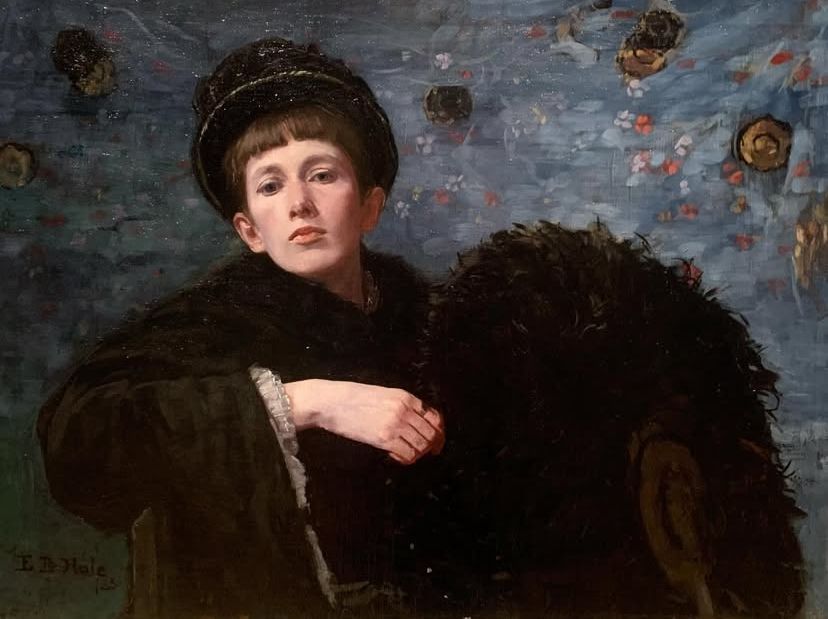
Ellen Day Hale, Self Portrait, 1885.
Collection of, Seen at Museum of Fine Arts, Boston.
ART ADVENT #16 / Dec. 15
I absolutely love the raw and confrontational series Jeanne Bieruma Oosting made of sex workers in Paris. The graphic works don’t idealize or romanticize, but show these women’s realities in all their harshness. Bieruma Oosting came from a wealthy Frisian family, but her parents cut her off when she decided to pursue an artistic career – and decided to never marry. Like many 20th-century women artists, she was quite well-known in her time, then forgotten, and since a few years her work has deservedly so resurfaced due to a fantastic biography and a series of exhibitions.
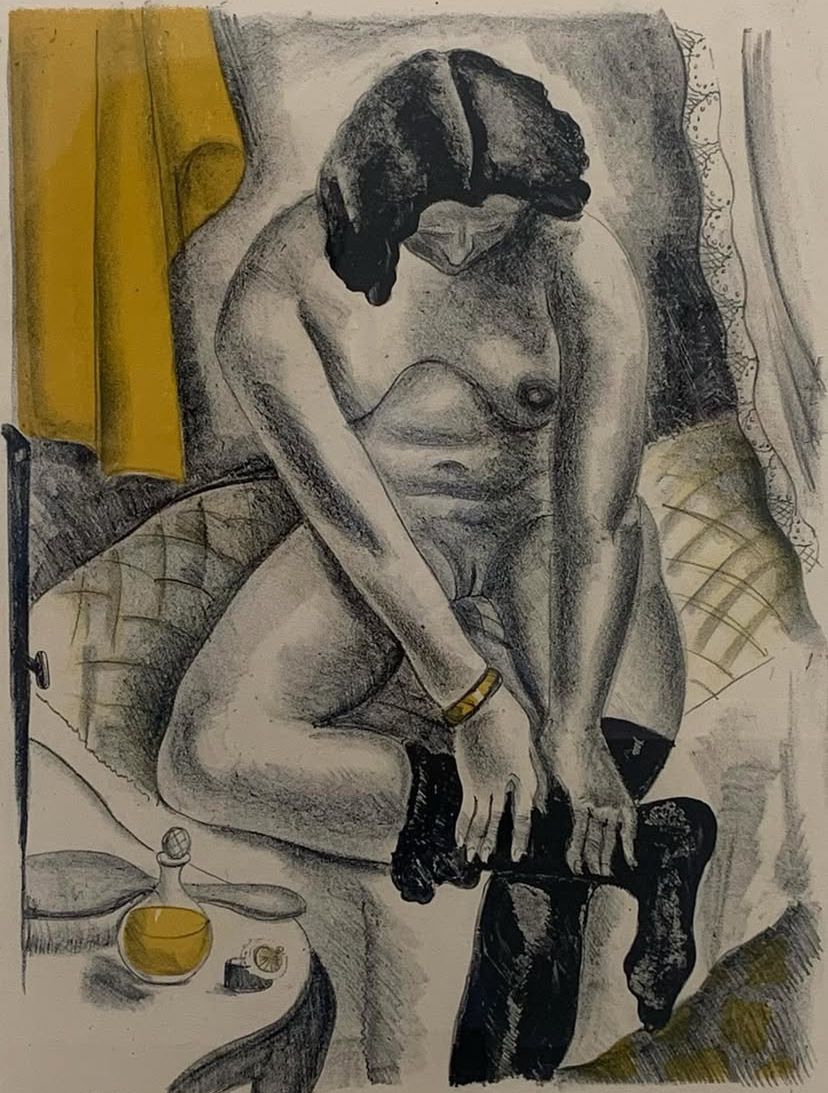
Jeanne Bieruma Oosting, Nude, ca. 1930
In collection of, Seen at Museum Belvedere, Oranjewoud, on long term loan from De Ottema Kingma Stichting.
ART ADVENT #17 / Dec. 16
Joan Mitchell was one of the few women painters of her time that gained critical acclaim during her lifetime. Her work can be described as abstract expressionist, it is not meant to represent anything but is all about evoking emotion and subjective experience instead. Mitchell’s work is always related to her personal memories of landscapes she has experienced. She once told an interviewer, “I carry my landscapes around with me.” The title of this work refers to a line in the poem “The Domination of Black” by Wallace Stevens, in which colors heavily impact the narrator’s psyche. In Mitchell’s Hemlock, strokes of black find their way through thick patches of white interspersed with color. The materiality of her work is just genius. She proclaimed Henri Matisse to be one of her main influences. “If I could paint like Matisse, I’d be in heaven,” she once said.
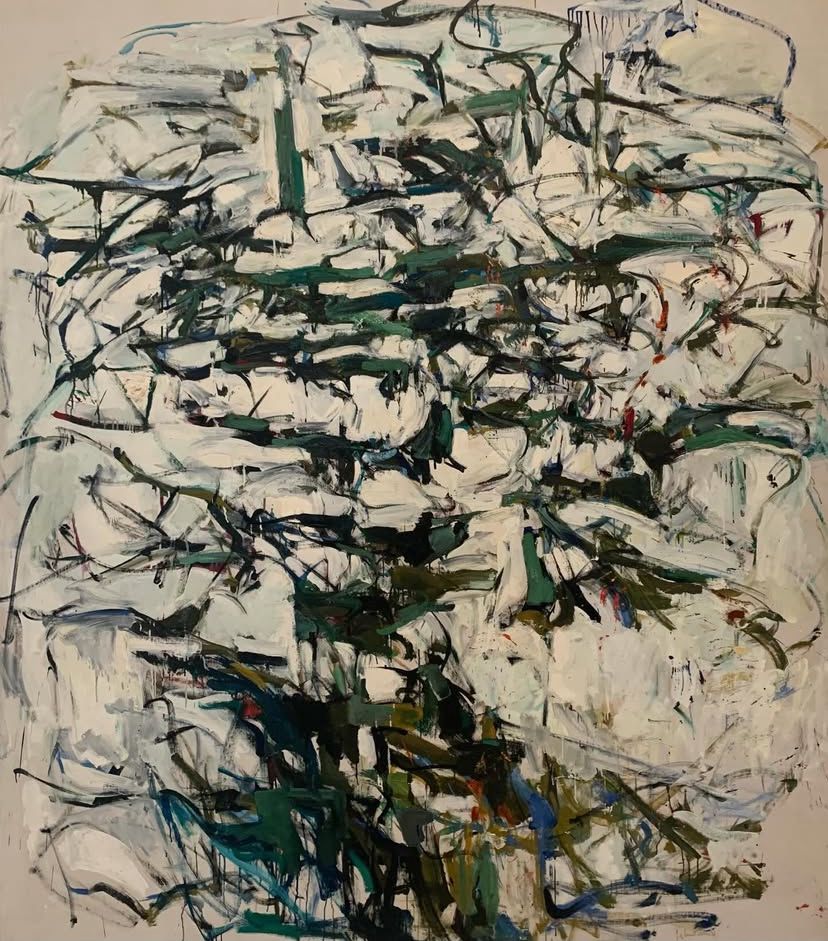
Joan Mitchell, Hemlock, 1956
Collection of, Seen at Whitney Museum, New York.
ART ADVENT #18 / Dec. 17
Recently I read a beautiful and haunting book by Caro van Thuyne. For a year she looked at, and collected images from, the world’s news as if it was happening to her personally. Instead of turning away from all the horrible things happing, she let it confront her face first. The book she wrote in a mesmerizing style, not only describing the many press images on a basic human level, but also from an attempt to embody their emotional dimensions through language. It became a plea for radical empathy. Van Thuyne begins her book with this iconic sculpture, Käthe Kollwitz’ Pietà. The grieving mother is simultaenously a universal image of the grieving parent, and a self-portrait. Köllwitz made this sculpture 23 years after she had lost her 17-year old son to WWI in 1914.

Käthe Kollwitz, Pietà, 1937
Collection Van Gemert
Seen at Museum Catharijneconvent, Utrecht.
ART ADVENT #19 / Dec. 18
Dutch painter Charley Toorop is probably best known for her stark (self) portraits with their mesmerizing eyes. But I also have a soft spot for her landscapes and still lives. She started out with these as younger artist, creating these paintings that have an equally stark expression and soul to them. Here is her View on Utrecht, made in 1917 when she was 26 year old. Charley was the daughter of Jan Toorop, who had been a nestor to the early modernist art world in the Netherlands. She tried everything in her power to be an artist different than her father, to be singular in her own way. In turn, Charley’s son Edgar Fernhout, who also became an artist, was adamant about being a different artist than his mother. Both artistic and family dynamics make the Toorops a fascinating part of Dutch 20th-c. art history.
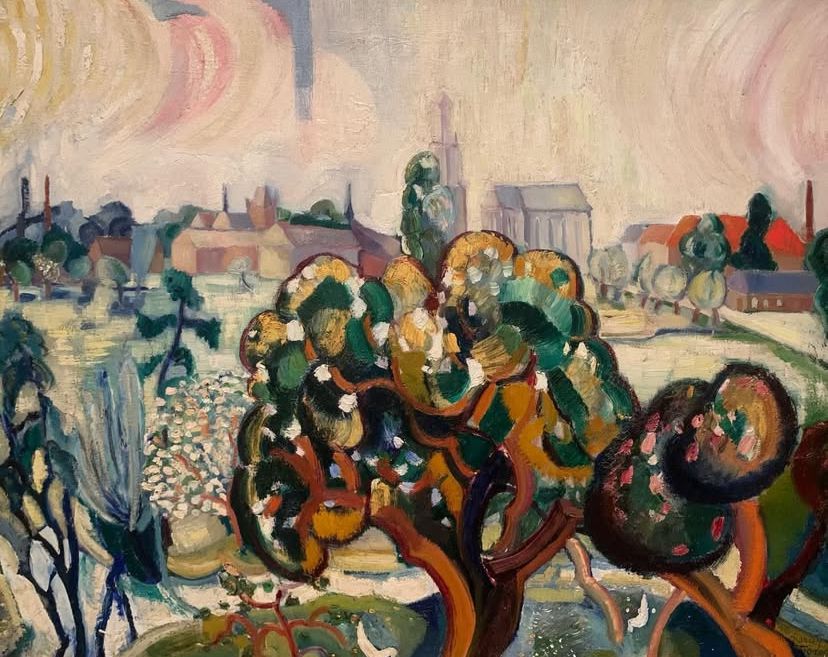
Charley Toorop, View on Utrecht with Apple Tree in Blossom, 1917.
Collection of, Seen at Centraal Museum, Utrecht.
ART ADVENT #20 / Dec. 19
It was such an unexpected pleasure to see this small work in the modern European arts section of the MFA in Boston. I knew it from the books, and we had requested it for the Mary Magdalene exhibit back in 2021. As it is part of the permanent displays, the loan was not granted, and it kind of slipped my mind where it was located. Until I was in Boston, turned a corner, and there she was!! In the most unexpected of places: the applied arts section about 19th c. fascination for Japanese prints and fabrics. And yes, the interior in which this modern Magdalene is located is indeed filled with such fabrics. But above all, for me, she exemplifies the dominant sexual and physical moral projected onto women. Turning away, modestly, ashamed for her nudity, due to the gaze that we (you and I) cast at her. I find it a mesmerizing, telling painting, but it also saddens me as it is perhaps a bit too recognizable to my liking. Yet, it was an encounter to remember.
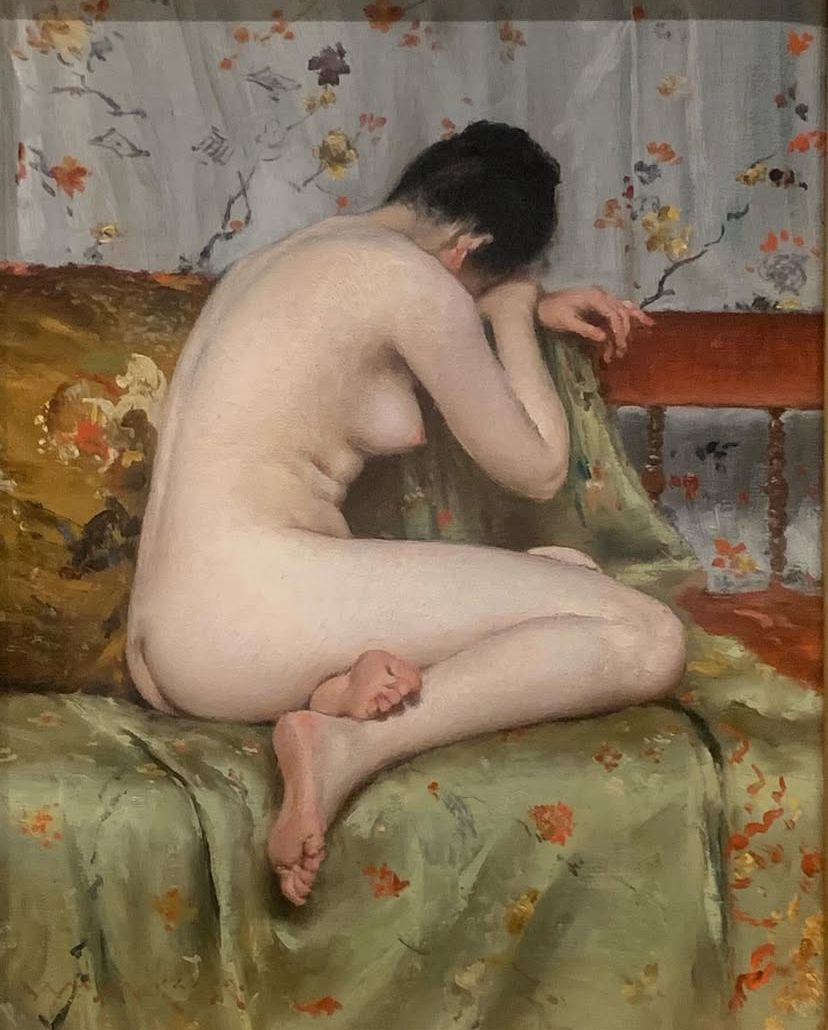
William Merritt Chase, A Modern Magdalene, ca. 1888
Collection of, seen at Museum of Fine Arts, Boston.
ART ADVENT #21/ Dec. 20
One of my favorite exhibitions this year was Fiona Lutjenhuis’ solo at 1646 in The Hague. It was a total installation, with wall paintings, her (by now) iconic room dividers, sculptures, bread installations and a soundscape. With an abundance of symbols and visual atmospheres, she completely drew me in. For her work, Fiona draws on her younger years growing up in a religious cult and the feelings and emotions that still accompany her from that time. She surrounded the visitors to this exhibition with both feelings of eeriness and embrace. One of the ways she achieves this, is to create rotating doors which you have to step through in order to reach a new part of the exhibit (which is why I chose this photo). For me, this duality of eeriness and embrace is key to everything she makes. I can’t wait to see where she will take her work next. Fiona was one of the four nominees for this year’s Prix de Rome (NL). Although she was not awarded the prize, for me she certainly was the winner.
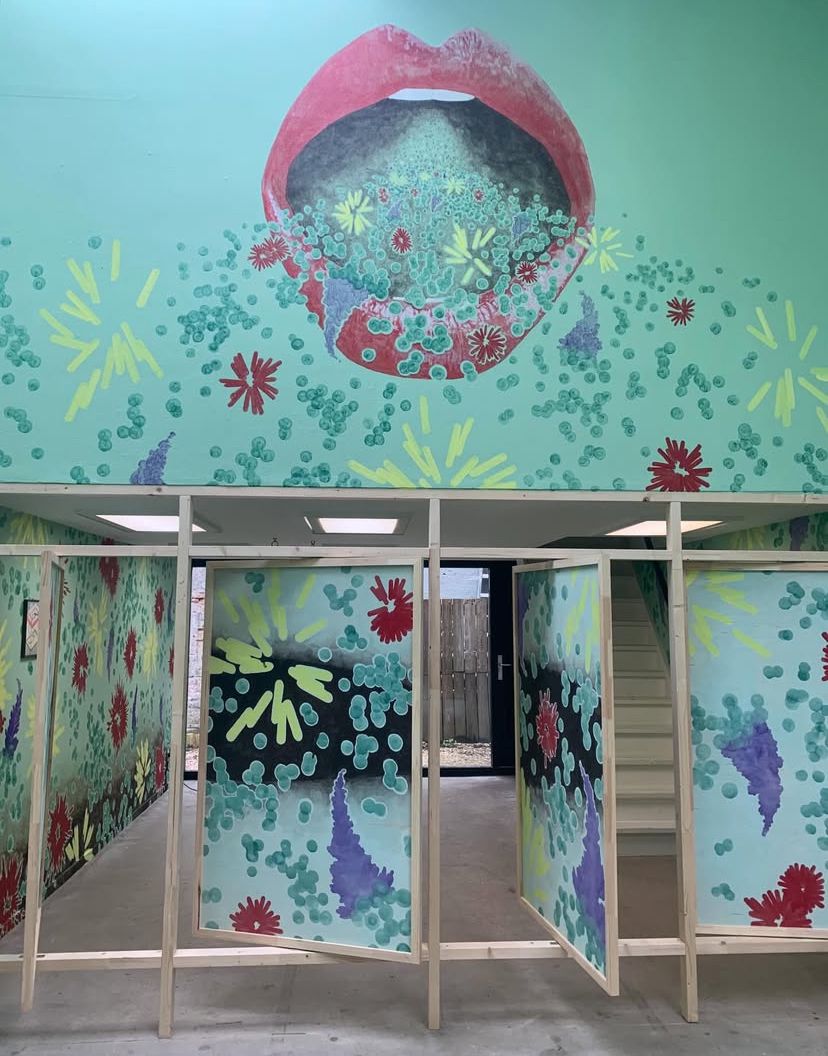
Fiona Lutjenhuis, Ankhmania (detail of exhibition space), 2025.
Seen at 1646, The Hague.
ART ADVENT #22/ Dec. 21
For the shortest day, I chose a work by one of my favorite light artists: James Turrell. Seeing a work by Turrel when I was in high school, was my first encounter with contemporary art. Until then, I had had no real experience with it. Being led into one of Turrell’s Wedgework installations during a schooltrip, taking the time to sit down and letting your eyes get used to the light: I suddenly understood how art could be about perception. About your state of being at a certain moment in time, and how art has the power to transform that state of being – if only for a little while. This summer it was such a pleasure to see Turrell’s red installation in Denmark again, with subtle yellows and blue. The primary colors that invoke a miraculous spatial experience. It made me have an experience of wonder again, similar to that very first experience.
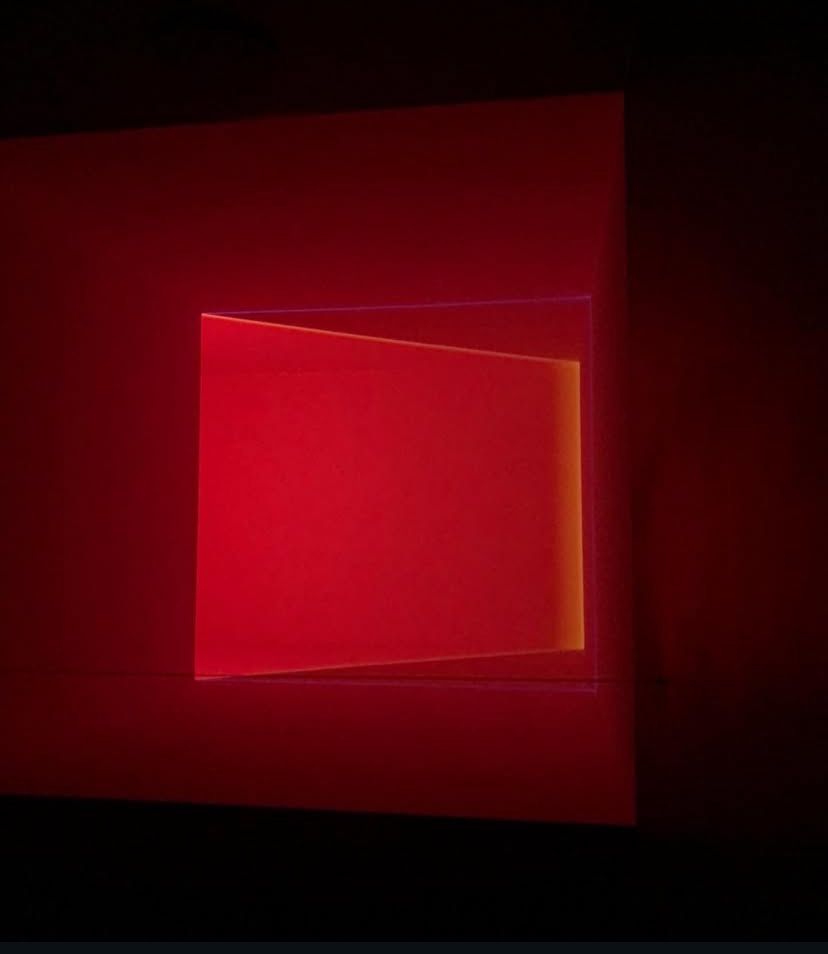
James Turrell, Milkrun III, 2002.
Collection of, Seen at AROS, Aarhus.
ART ADVENT #23 / Dec. 22
Another icon I got to see for the first time in my life this year: Edward Hopper’s Nighthawks. I fully understand why this is an icon. What a magnificent painting! The sense of loneliness it embodies is strongly palpable. Hopper made it to evoke the loneliness of life the city. People living in close vicinity but completely along side each other, without really making valuable contact. The abnormal cleanliness of the street and the absence of other urban details heightens the eeriness of the scene, and with that the sense of these figures being alone together.
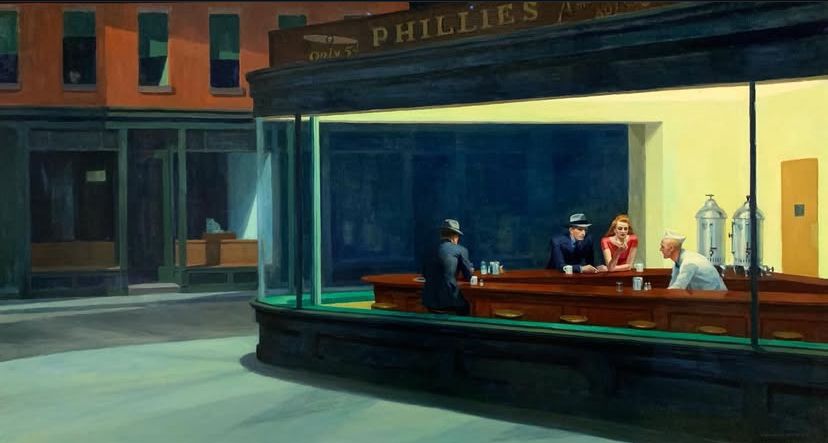
Edward Hopper, The Nighthawks, 1942.
Collection of, Seen at the Art Institute, Chicago.
ART ADVENT #24 / Dec. 23
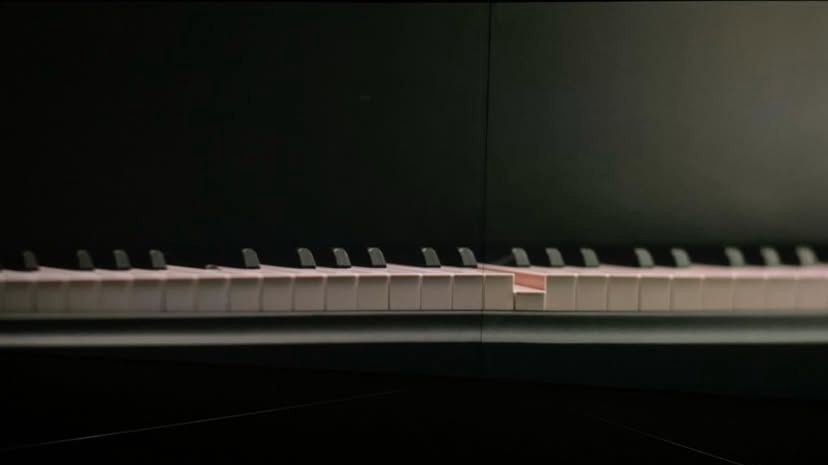
I’m looking forward to a new year in which music will play a bigger role in my professional life again. It’s one of the reasons why I think fondly of having seen this installation during my summer holiday in Denmark. In the basement of the Aros museum in Aarhus, several rooms are especially dedicated to installation art. That floor is all about immersion, perception and the senses. The installation “Take Over” by Anri Sala addresses all: two screens on which a piano is played are combined with two transparent glass walls – which together constitute a cross form. The sounds produced by the piano play are from two famous compositions: the Marseillaise, and the Internationale. Both musical compositions are tied to revolutionary events and ideologies in history – Sala is intrigued by the narrative potential and power of musical sounds. In the installation at first hands are playing the pieces, but after a while the piano plays itself – the system has taken over. A fascinating allusion to the power of the collective, which can be both frighteningly out of control and a beautiful sense of connectedness.
Anri Sala, Take Over, 1974
Collection of, Seen at AROS, Aarhus.
ART ADVENT #25/ Dec. 24
I long doubted what to select for the final Advent post. A post to mark the culmination of many days of anticipation, of the coming of light, and of promise. The celebration of new life, a glimpse of eternity. It’s beautiful and warm. Yet, I didn’t manage to select a glowing, celebratory artwork. There’s simply too much going on in the world. The many crises humans have caused to itself and others, are endlessly entangled and we seemingly cannot find a way out. So, I chose this print by Kathe Köllwitz, whose Pièta was featured in the Art Advent before. Köllwitz lost her son in WWI, she portrayed many mothers who shared the same life-changing experience. This print is titled Mothers – and to me expresses the endless love parents feel for their children, the enduring worry and fear they experience as children grow up to become adults in a world full of uncertainty, and the simultaneous power and powerlessness they endure in making this world a safer place. As we are heading towards Christmas and the new year, I wish for wisdom for the powers that be and somewhat more kindness and care for those in need. It honestly is not that hard, why do we keep failing? Remember what’s at the heart of Christmas: a newborn family who were refused access, hospitality and care, fleeing from persecution, while eventually bringing hope and light for so many across the world. Let’s try to see the light in one another a little more in the new year ⭐️✨💫

Kathe Köllwitz, Mothers, 1919
Collection of Kunstmuseum, The Hague
Seen at Centraal Museum, Utrecht.

 dr. Lieke Wijnia