
It’s Advent time again, so here’s another round of Art Advent, during which I post inspiring, cheerful or consoling artworks I’ve seen over the past year. With 2024 being particularly rough with the world going mad on so many fronts, I continue to believe in the power of art and putting beauty, fragility and love first – in anticipation of the new year to come. I hope you’ll join me on this Art Advent once again!
The Art Advent gets daily updates on my social media and within the blog posts on this site.
ART ADVENT #1 || Dec. 1.
Feeling overwhelmed by the hateful, destructive and incompetent forces in our world, I saw this painting a couple of weeks ago in Brussels and its intimacy captivated me. The style is reminiscent of French modern artists like Pierre Bonnard and Edouard Vuillard, who celebrated the homely through lavish patches of color. But this is very much a contemporary artwork. Two women, on a couch, in a private moment. Especially note the hand up the trouser leg. Such nonchalant caress, masterfully captured by the painter. A vivid reminder that in the end, despite all, it is love that remains.
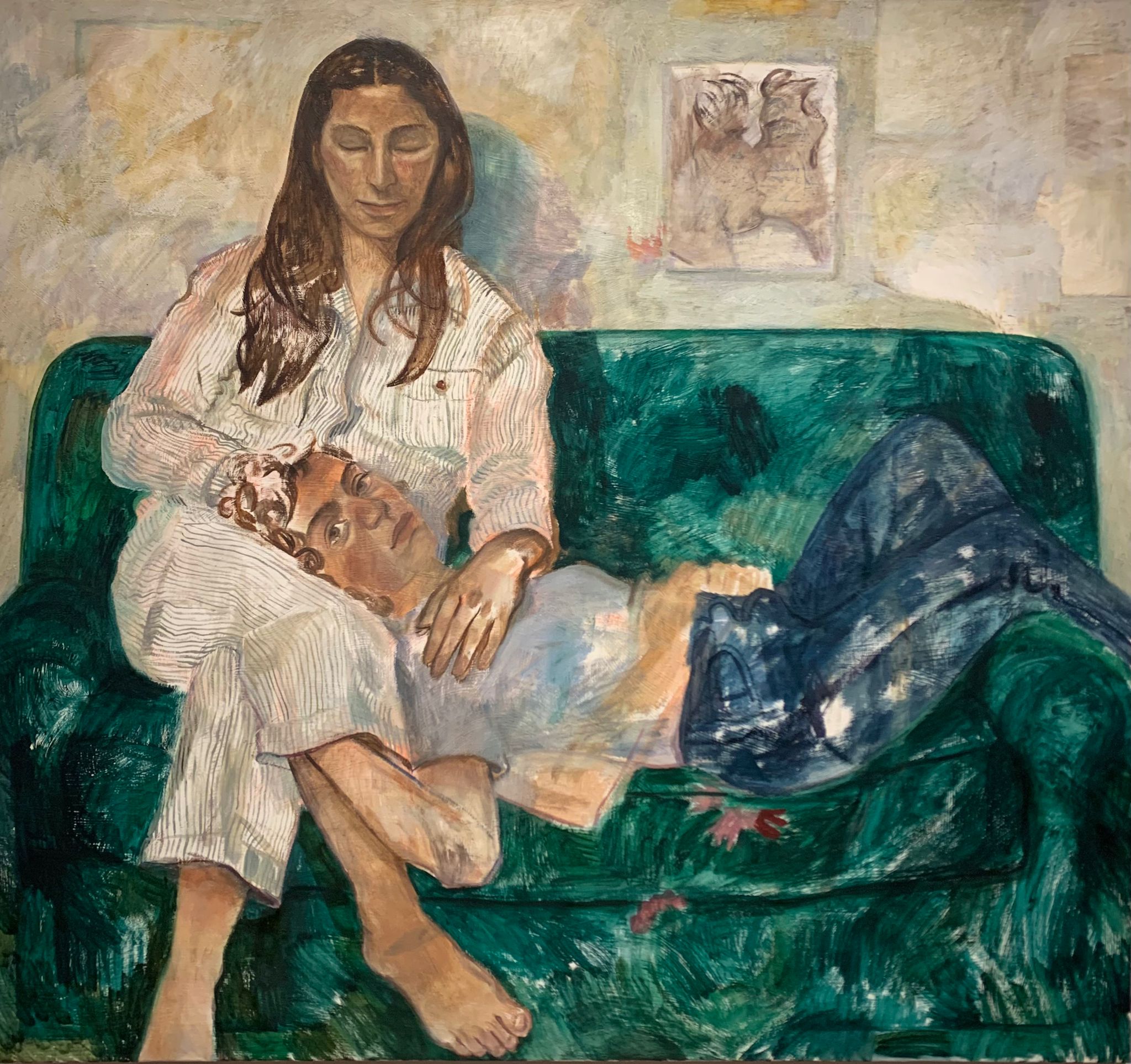
Nathanaelle Herbelin, Claire et Cécile, 2022-2023.
Seen at Bozar, Brussels
Courtesy of the artist and Xavier Hufkens, Brussels.
ART ADVENT #2 || Dec 2.
The theatre is not only a place to admire what’s going on on the stage, but is also very much a place to see and be seen, socially. Especially in late nineteenth-century France, theatre visitors were a popular subject matter in art, used to express ideas about social (in)decency and power play. This is a fantastic painting by Éva Gonzalès, who portrayed her sister and future husband in a box at the Théatre des Italiens. Gonzalès submitted this painting to the 1874 Paris Salon, where it was rejected for display. Her work contradicted preconceived ideas of what women artists’ work should look like: feminine and delicate. And not playing in the same league as male artists, which Gonzalès certainly aimed at with this painting. She, however, also refrained from showing the painting at the 1874 (in)famous first Impressionist exhibition. Instead, she posted a newspaper advert saying this painting was on display in her studio and could be admired there.
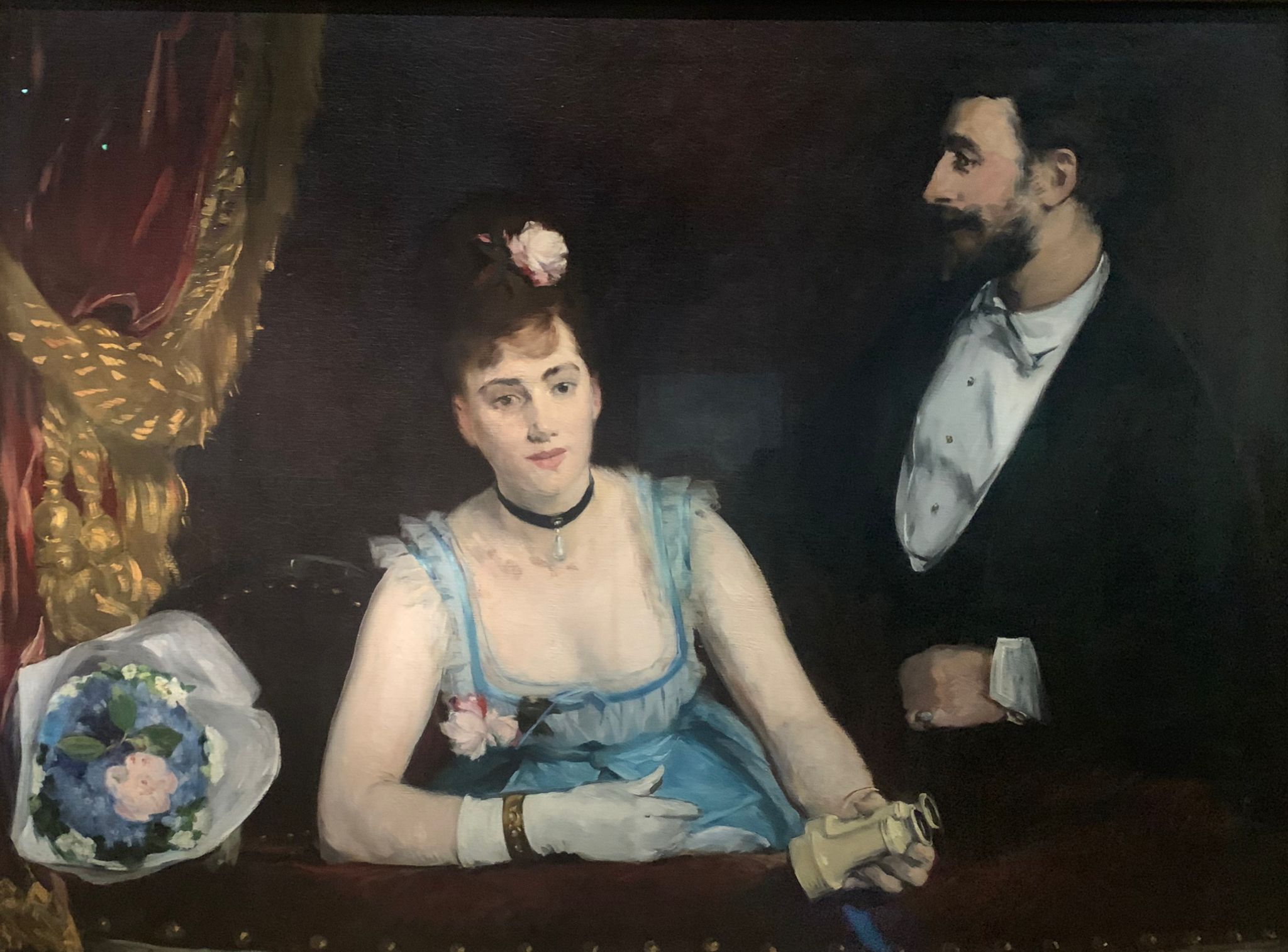
Éva Gonzalès, Une Loge aux Italiens, ca. 1874.
Collection of, Seen at Musée d’Orsay, Paris
ART ADVENT #3 || Dec. 3
This might seem like an ordinary mountain landscape painting. Yet, there’s more to it than might meet the eye. In the mid-19th century, when this was painted, scientific understandings of natural processes were rapidly developing. Theorists thought the earth looked the way it did as a result from either rapid changes through catastrophes, or slow continuous ever ongoing changes. Many of them initially tried to reconcile scientific ideas with existing Christian beliefs and biblical narratives. Glaciers were seen as God’s means of sculpting the earth. This painting was mean to suggest how the landscape was formed through the Biblical flood – one of the most telling catastrophes recorded in the Bible. My curatorial work for the “The Genesis of Science” exhibition has made me especially fond of these types of images.

John Brett, Glacier of Rosenlaui, 1856.
Collection of, Seen at Tate Britain, London.
ART ADVENT #4 || Dec. 4.
Probably the most unexpectedly beautiful museum I have visited this year was the DIMU in Freising. This diocesan museum was reopened in 2022 after extensive renovations by architects Brückner & Brückner. The aesthetics of the designs and displays are just phenomenal. The arch shape is a returning feature, this photo is of the entry hall on the ground floor. On the wall a reference to Proverbs 1.7: “The fear of the Lord is the beginning of knowledge, but fools despise wisdom and instruction.” In the entry hall, only this sculpture by Berlinde de Bruyckere is placed. De Bruyckere created the figure of the Arcangelo in 2020, in response to the covid pandemic. To her, the archangel is a figure of refuge and shelter, as well as fragility and finitude. This duality symbolizes the forces of Eros and Thanatos, recurrent features in de Bruyckere’s oeuvre. I find the Arcangelos, which she has displayed in various places around Europe, breathtakingly beautiful. Whenever I see one, I feel a sense of protection, like an arm around me, but also of heaviness and sadness. It’s life’s duality, with love and loss going hand in hand.

Berlinde de Bruyckere, Arcangelo, 2023.
Collection of, Seen at Diozesan Museum, Freising
ART ADVENT #5 || Dec. 5.
One the most impressive pavilions at this year’s Venice Biennale was that of Poland. The collective Open Group displayed a film installation, in a surreal karaoke bar inide the pavilion. The protagonists of the displayed films are civilian refugees from the war in Ukraïne and they give expression to their war experiences through repeating the sounds of weaponry as they remember it. On film they imitate the sounds of bombs, missiles, granates, guns, and invite the visitors to repeat after them through the microphones installed in the space. They sounds are subtitled at the bottom, in order to “sing along”. Visitors can also take place at little tables, as if in a bar indeed. The sounds form a universal collective memory of war, as experienced by those subjected to armed conflict around the world. When life is in danger, sensory experience can be key to survival. Sharp sight or a vigilant ear can mean life or death. While all the film’s participants managed to escape the war, they carry the embodied memories of war sounds with them for the rest of their lives.
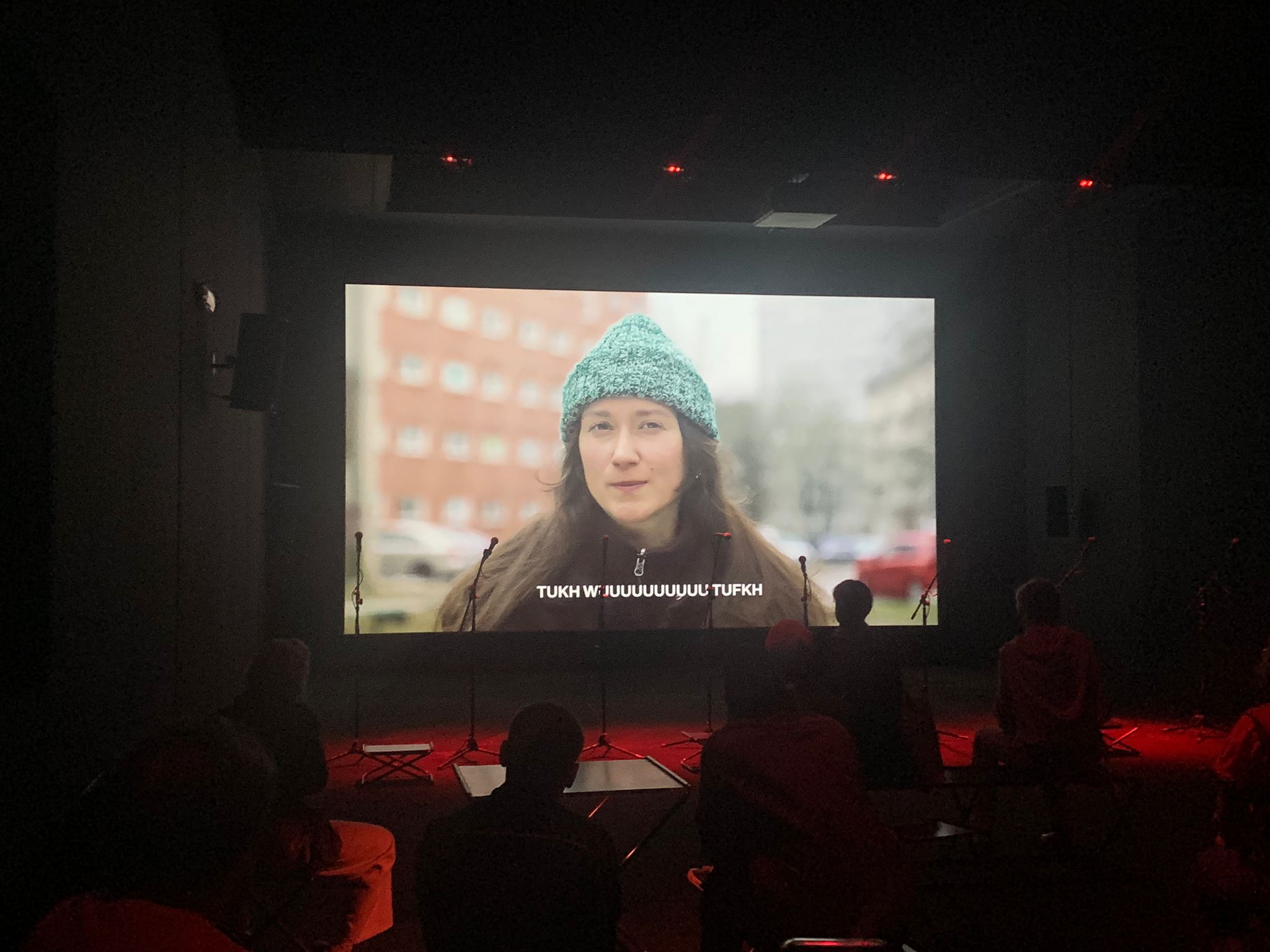
Open Group, Repeat After Me II, 2024.
Seen at Polish Pavilion, Venice Arts Biennale.
ART ADVENT #6. || Dec 6.
In 2019 artist Joyce Overheul spent a month in Teheran. She made this banner with the telling slogan “Men of quality do not fear equality” with which she went into the streets and shops to photograph men supporting this message. It resulted in a series of many men posing with the banner. After a rage-filled week because of so much political incompetency and societal polarisation going on, this photo provides at least a glimmer of hope for some kind of alternative.

Joyce Overheul, Men of quality do not fear equality, 2019.
Collection of the artist, Seen at Centraal Museum, Utrecht
ART ADVENT #7 || Dec. 7.
A novel I greatly admire is Ali Smith’s “Autumn” (2016). The first of her seasonal quartet is my favorite, it’s profound, truthful, funny and at times a bit weird. It’s non-linear storytelling in optima forma. Artist Pauline Boty has a strong presence in this novel, and on the last page this painting “The Only Blonde in the World” is printed. Boty painted Marilyn Monroe from a photograph, one year after she had passed away. The painter recounted how she had felt like she was painting a present-day mythology by putting an image of Monroe in paint on canvas. Her status had been larger than life, and perhaps still is. Many of the challenges Monroe had faced in life, Boty recognized in the Pop-Art circles she was part of as well. In a time when these were seen as mutually exclusive, she wanted to be taken seriously intellectually and to be free to to embrace her sexuality. A challenge many women will still recognize today. Non-linearity is a defining feature here as well, we are continuously faced with the same sh*t. Fortunately there are artists who give us imagery and words to deal with it.

Pauline Boty, The Only Blonde in the World, 1963.
Collection of, Seen at Tate Britain, London


 dr. Lieke Wijnia